
For Chairs and Boards
Fleet is a governance issue. Make sure yours is under control.
CarCloud brings vehicle compliance, valuations, insurance, cost and risk data into one governed platform — so the Board gets the assurance it needs on duty of care, capital deployed and control integrity, without relying on a spreadsheet trail.
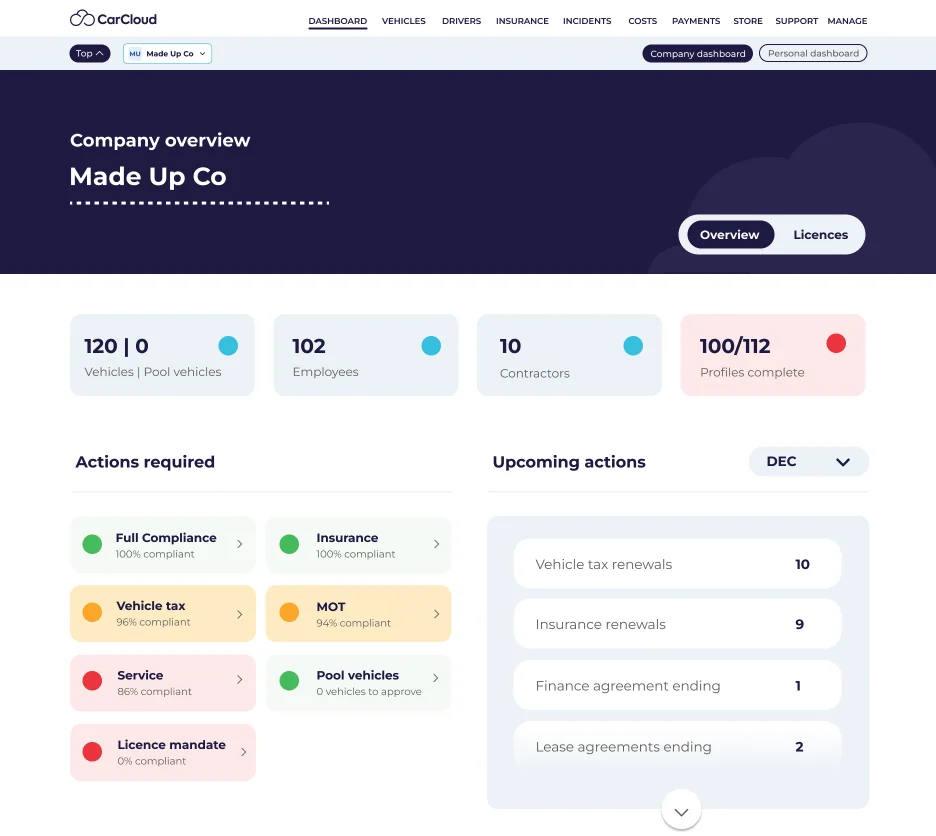
From the CarCloud platform
The numbers
Fleet risk is bigger — and closer to the Board — than most Boards realise.
459
people were killed in collisions involving a driver driving for work in Great Britain in 2024 — around 29% of all road fatalities.
Government road safety data, 2024
14 million
grey fleet vehicles are still on UK roads in 2026 — employee-owned, but a company responsibility the moment they’re used for work.
Driving for Better Business / National Highways
91%
of fleet managers plan to increase investment in digital fleet technology over the next five years.
Bridgestone / Webfleet, 2024
79%
of fleet managers still manage vehicle costs on spreadsheets.
Fleet News / Sixt, 2025
The problem
Four things most Boards don’t see until something goes wrong.
Duty of care sitting outside Board oversight
Where employees drive for work — owned fleet or grey fleet — the organisation carries legal duty-of-care responsibilities. Too often, this sits with an operational team and never reaches the Risk Committee.
CarCloud gives the Board a live, evidenced view of driver and vehicle compliance across owned and grey fleet, so duty of care is a reporting line, not an assumption.
Capital tied up in vehicles with no clear line of sight
Fleet is a deployed asset base — vehicles depreciate, incur cost, and influence insurance and ESG performance — yet it rarely gets the scrutiny given to property or IT.
CarCloud provides real-time, market-based valuations and total cost of ownership data, so the Board can see fleet as a financial asset, not just a cost line.
Governance running on spreadsheets and email trails
Spreadsheets fail in exactly the way Boards fear most: silent errors, weak access control, no audit trail, key-person risk. If compliance evidence and cost data are manually collated, the control environment is fragile.
CarCloud replaces spreadsheet dependency with a single governed platform — automated checks, audit trails, and one source of truth.
No clear line between risk, cost and performance
Board packs often separate safety, cost and asset data, making it hard to ask — and answer — the questions that matter: is our fleet safe, efficient, and optimised, all at once?
CarCloud links compliance, cost and performance data in one audit-grade report, built for the Board and Risk Committee.

Ask the fleet question once, and get an answer you can rely on.
Compliance, cost and risk on one dashboard, evidenced for the Board rather than assembled for it.
What changes
The oversight a Chair inherits, and the one they can put in place.
The situation you inherit
Fleet governance absent from Risk Committee agendas
Grey fleet treated as a reimbursement line, not a risk population
Compliance evidence scattered across spreadsheets and email
Vehicle valuations and TCO based on assumption
No clear executive accountability for road risk
Board reporting inconsistent, hard to benchmark quarter to quarter
Risk and asset value assessed separately, if at all
With CarCloud
Fleet governance embedded in Risk Committee reporting, with clear KPIs
Grey fleet verified and monitored as a controlled population — licence, insurance, MOT, tax
One governed platform: audit trails, not email trails
Real-time, market-based valuations and total cost of ownership
Defined ownership across Finance, HR, H&S, Procurement and Fleet
Audit-grade Board reporting: consistent definitions, trends, actions
Risk, cost and performance reported together, in one dashboard
How it works
One governed platform. A Board pack you can stand behind.
CarCloud brings vehicle, driver, compliance, cost and performance data into a single platform — covering owned fleet and grey fleet together. It automates compliance verification (licence, insurance, MOT, servicing), captures mileage and emissions for ESG and SECR reporting, tracks total cost of ownership and asset utilisation, and produces audit-ready reporting that links risk, cost and performance for the Board and Risk Committee.
Compliance & Risk
Automated checks and alerts, owned and grey fleet.
Asset & Cost Visibility
Real-time valuations, total cost of ownership, utilisation.
Board & Audit Reporting
Consistent, decision-grade, evidenced.
Governance Maturity Tracking
Spreadsheet dependency, data latency, audit trail completeness.
Confidence you can bring to the table
Ask sharper questions. Get evidenced answers.
A Chair doesn’t need to manage the fleet. But the Board does need to know:
?
Who owns road risk and asset performance at Executive level?
?
Are we managing grey fleet — or simply reimbursing it?
?
Are vehicles treated as controlled assets with a lifecycle strategy?
?
Are our controls system-led, or spreadsheet-led?
If the answer relies on spreadsheets, it may be time to rethink.

Drive your business with CarCloud DRIVE.